Reviewed · DUBLIN TOURS
Women Of Ireland: Trailblazers & Pioneers
This tour is interesting because it reframes Dublin through women who refused to stay in the margins, from independence fighters to suffragettes and activists. I love that you get a focused walk with real places to anchor the stories, not a list of names to forget.
I also like how guides such as Tara and Ciarán are praised for keeping the pace friendly and the info at the right level for different interests. One thing to consider: it is mostly an outdoor stroll with short stops, so if you want long, indoor museum time, you will need to plan extra time on your own.
Key highlights to look for
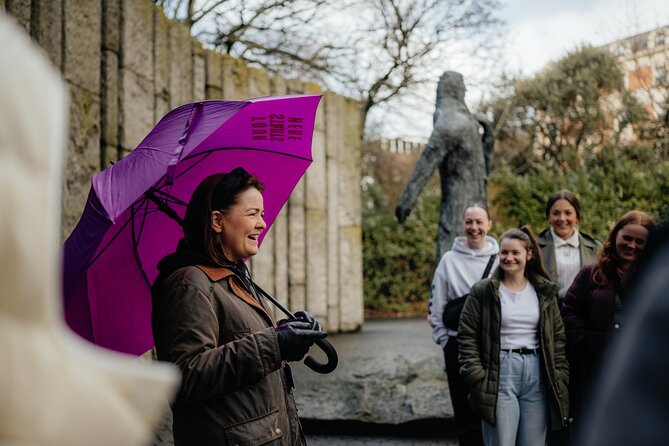
- Small group up to 14 people, so the walk feels personal instead of crowded
- Most stops are free, including time in Dubh Linn Gardens
- You meet at St Stephen’s Green, an easy starting point near public transport
- You pass major sites linked to 1916 and women’s activism, even when the tour does not enter buildings
- A strong guide-led storytelling style, with anecdotes that keep it light
- You finish at Dublin Castle gardens, with modern Ireland context
Women of Ireland: a smarter Dublin story than the usual highlights
Dublin can feel like a two-track city. You have the famous writers and iconic landmarks, then you have everything that happened underneath the headlines. This tour chooses the second track, following women who shaped Ireland while the credit often went elsewhere.
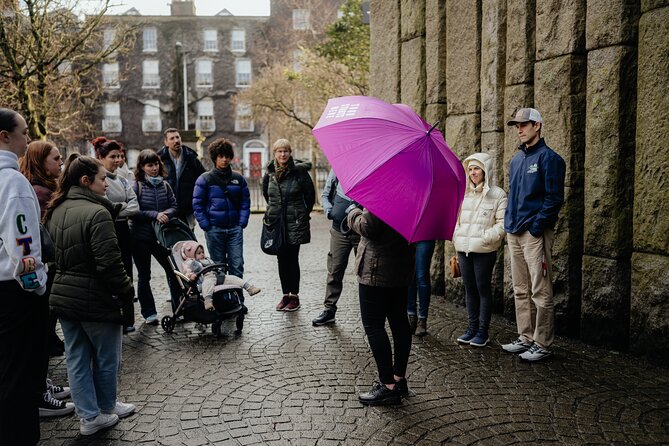
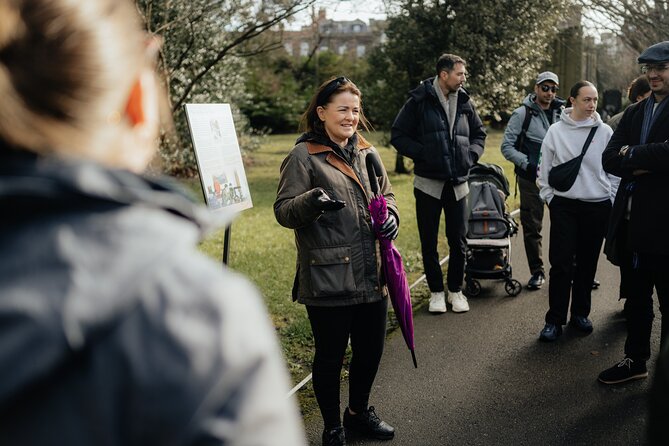
What makes it work is the format. You are not staring at a single plaque and moving on. You walk between stops around central Dublin, spending about 15 minutes per location, and the guide ties each woman to a place you can actually see. That matters in a city like Dublin, where the streets and public spaces do a lot of the storytelling.
The small-group size also changes the vibe. With a maximum of 14 people, the group stays easy to manage and more interactive. If you like asking a question, you are more likely to get an answer that fits what you actually care about, not just a generic script.
Other ways to spend a day in Dublin
- Dublin to Cliffs of Moher, including Wild Atlantic Way and Galway
★ 5.0 · 23,331 reviews - From Dublin: Cliffs of Moher, Burren & Galway City Day Tour
★ 4.8 · 18,888 reviews - Dublin: Guinness Storehouse Entry Ticket
★ 4.6 · 16,863 reviews
St Stephen’s Green meetup: Countess Markievicz and the start of the rebellion
You begin at Wolfe Tone Sculpture in St Stephen’s Green, and that is a smart pick because St Stephen’s Green is both central and familiar. Your guide gets you oriented right away and introduces Countess Markievicz, including her role in Ireland’s fight for independence.
This first stop sets expectations. It is not just biography. The guide frames Markievicz as a real actor in political change, which helps you understand why the rest of the women on the route feel connected, even when their causes were different. If you have only limited time in Dublin, this opening acts like a mental map.
Practical note: you will be outside for this part, and the Green can be breezy depending on the day. Bring a light layer so the cold does not cut your attention short.
Royal College of Surgeons area: Margaret Skinneder and 1916, without going inside
Next, you head to the Royal College of Surgeons area. Even though the tour does not enter RCSI, the guide talks about women connected to RCSI during the 1916 Rising, including Margaret Skinneder.
This is one of the clever parts of the experience. You are still grounded in a real location, but you save time that a building visit would require. In about 15 minutes, you get the main ideas and the emotional context, then you move on while the story stays fresh.
If you are the type who likes to go inside every site, this is a possible mismatch. But if your goal is learning through a walk and keeping momentum, skipping the interior works in your favor.
Also, since it is not an inside stop, you can spend your mental energy on the women’s role in the uprising, rather than getting distracted by an unrelated museum experience.
Mercer Street Upper: Margaret Anne Cusack, The Nun of Kenmare
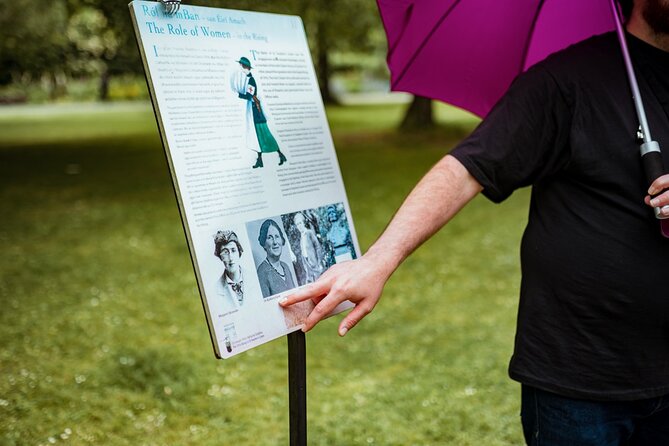
At Mercer Street Upper, the tour shifts from independence politics to service and moral courage with Margaret Anne Cusack, often linked to the title The Nun of Kenmare.
What I like about placing Cusack here is the contrast. Dublin has no shortage of political monuments, but fewer stories are told through the lens of reform, care, and organized community action. This stop helps you see rebellion in a broader sense. Sometimes it is street-level defiance. Sometimes it is institution-building and pushing society to act differently.
This is also one of the stops that can surprise people. Even if you have heard the name of an Irish writer or a famous statesman, you might not have met Cusack before. The guide’s job here is to make her feel relevant to the present, not like a random historical footnote.
If this is not quite it, Dublin also does these:
- Dublin to Cliffs of Moher, Burren, Wild Atlantic Way, Galway Tour
★ 5.0 · 12,924 reviews - Dublin to Belfast Black Cab, Dunluce Castle and Giant’s Causeway
★ 5.0 · 7,954 reviews - Kilkenny, Wicklow Mountains & Glendalough Day Tour from Dublin
★ 5.0 · 7,897 reviews - From Dublin: Wicklow Mountains, Glendalough & Kilkenny Tour
★ 4.8 · 6,235 reviews
Ship Street Great: suffragettes and Hannah Sheehy-Skeffington
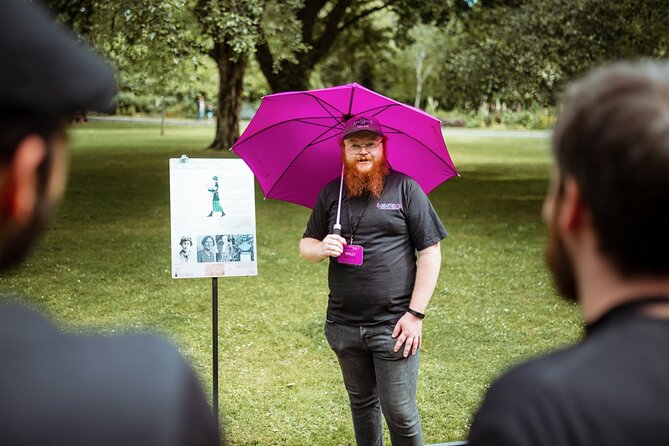
Then comes Ship Street Great, where the focus lands on the suffragette movement and Hannah Sheehy-Skeffington.
This part is valuable because it connects women’s rights to the wider momentum of Irish resistance. Instead of treating suffrage as a separate story that happened in a different corner of Europe, you get it framed as part of the same era of pressure, organizing, and conflict over who gets power.
If you care about how social change actually happens, this stop is a good one. The suffragette movement was not only about laws. It was also about public debate, organizing, and forcing uncomfortable conversations into the open.
Dubh Linn Gardens: Veronica Guerin, and the one stop you actually enter
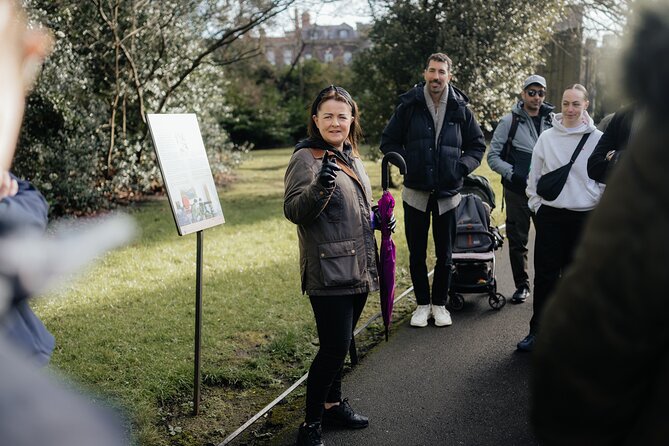
The tour heads to Dubh Linn Gardens, and this is where the experience becomes more than just street-side commentary. The tour enters the gardens while the guide explores the life of Veronica Guerin.
This is your “slow down” moment. In a garden setting, the storytelling tends to land differently. You have a calmer physical space, which helps the guide focus on Guerin as a modern figure compared to the earlier independence and early-20th-century movements.
It also helps you get variety. Out of the six stops, this is the one where your feet stop doing all the work and you get a real pause to take it in. If the rest of the walk feels fast, this stop often becomes the emotional highlight.
Dublin Castle ending: Anne Devlin and modern Ireland context
The final stop brings you to Dublin Castle area, where you finish at Dame St, Dublin 2, specifically in the gardens of Dublin Castle. The tour does not enter Dublin Castle, but the guide wraps up with the history of Anne Devlin and how it connects to modern Ireland.
Ending here is smart because it gives you a visual anchor. You are in the orbit of a site that is strongly associated with Irish history and power. Even without going inside, the surroundings set the stage for a “then and now” conversation.
Anne Devlin is a powerful choice for the finale because she bridges the older story of resistance into the larger arc of national identity. The guide also aims to bring the conversation forward, so you leave with more than names and dates.
Price and time: does it add up in a Dublin afternoon?
At $17.35 per person for about 1 hour 30 minutes, this tour is priced for people who want meaningful context without spending half a day. It is not a bargain in the “too good to be true” sense, but it is also not trying to compete with long museum experiences.
You also benefit from the structure. Many stops are free, and you are not paying extra entry fees at each location. That keeps the total cost predictable, which matters when you are planning a full day of Dublin meals and transit.
One more value point: because it is a small group, you get a guide rather than just a self-guided route. Even if you already know some famous Irish men, this kind of guided framing is often what makes the story feel new.
Booking smart: when to reserve and what to expect on the day
This experience uses a mobile ticket, so plan to have your phone ready for check-in. It also runs with eco-friendly operations, which you might notice in the guide’s approach and how the tour is managed around the city.
You will likely want to book ahead. The tour is typically booked around 24 days in advance on average, which is a useful clue that slots can go quickly when schedules line up. If you are traveling in peak periods or right around major weekends, early booking is your friend.
As for timing, it starts at 11:00am and lasts about 90 minutes. That makes it a good fit for:
- A morning plan that still leaves room for lunch and wandering afterward
- Someone who wants one organized history experience without locking up the whole day
Who this tour suits best, and who might want something different
This works especially well if you like:
- Stories about women who pushed boundaries in Ireland
- A guided walk where the places matter
- A small group experience with enough space to ask questions
- A pace that does not feel like a lecture
It may not be the best match if you want:
- Lots of inside building time
- Deep archival-style detail for every topic
- A long, museum-like format
Because the tour does not enter some major sites, it favors interpretation over access. That is not a flaw. It is simply a different style of learning.
Should you book Women of Ireland: Trailblazers and Pioneers?
I think you should book it if you want Dublin to feel more human and more political, through women you may not meet on the standard circuit. The small-group cap, the well-paced stops, and the fact that the guide story is praised for matching different levels of background interest make this a strong choice for real learning without heavy lifting.
Skip it only if you are mainly hunting for indoor admissions and long museum stops. If your ideal day is walking, short stops, and stories that connect across time, this tour is a practical, good-value way to spend an afternoon.
FAQ
How long is the Women of Ireland walking tour?
It runs for about 1 hour 30 minutes.
What is the meeting point and where do you end?
You meet at Wolfe Tone Sculpture in St Stephen’s Green and finish in the gardens of Dublin Castle on Dame St.
How many people are in the group?
The group is limited to a maximum of 14 travelers.
Do you enter Dublin Castle or the Royal College of Surgeons?
No. The tour does not enter Dublin Castle or the Royal College of Surgeons. It does enter Dubh Linn Gardens.
What is included in the price?
The tour includes a guide and small-group format. It is also eco-friendly. Admission tickets are not included for every stop, and some stops are free.
Can I cancel for free?
Yes. You can cancel up to 24 hours in advance for a full refund.
Newest Dublin reviews
- Dublin: Traditional Pubs Walking Tour with Local Guide★ 4.9 · 112 reviews
- Dublin: Cliffs of Moher, Ennis, & Bunratty Castle Day Tour★ 4.9 · 113 reviews
- Meet and Eat Dublin: Dublin Food Walking Tour★ 5.0 · 115 reviews
- Small Group-Dublin Walking Tours★ 5.0 · 116 reviews
- A Silent Disco Walking Tour★ 5.0 · 118 reviews
- 3-Day Southern Ireland Tour Including Galway and Kerry from Dublin★ 4.5 · 123 reviews
- From Dublin: Wicklow, Glendalough, Waterfall & Sheepdog demo★ 4.5 · 126 reviews
- Dublin: Guinness Storehouse Connoisseur Experience★ 4.8 · 123 reviews
Dublin Tours, compared.

Dublin to Cliffs of Moher, including Wild Atlantic Way and Galway
Read our review →
Cliffs of Moher, Burren & Galway City Day Tour
Read our review →

Dublin to Cliffs of Moher, Burren, Wild Atlantic Way, Galway Tour
Read our review →
Dublin to Belfast Black Cab, Dunluce Castle and Giant’s Causeway
Read our review →
Kilkenny, Wicklow Mountains & Glendalough Day Tour from Dublin
Read our review →
Wicklow Mountains, Glendalough & Kilkenny Tour
Read our review →