
Reviewed · HISTORICAL TOURS
Galway History Walking tour with Local expert – Private Group
Galway can feel like a postcard city until someone puts the stories back onto the stones. This private Galway history walking tour does that, and you’ll walk at a human pace with a local guide who points out what most people miss. I like the small private group format, and I like that the tour includes a voucher toward a visit to St Nicholas Collegiate Church. The main drawback is simple: it’s a walking tour that depends on good weather, so bring rain gear or plan for a reroute.
I also appreciate the way this route builds a sense of place. You start at Eyre Square, then move street by street through the places tied to Galway’s families, faith, trade, and politics, ending back where you began. If you get a guide like Ger Considine (a name that shows up often in past groups), you can expect clear explanations and room for questions, not a lecture.
At about 1 hour 55 minutes for an average visit, it’s long enough to get your bearings, but not so long you’ll hate your shoes by the end.
Key highlights worth caring about
- Private, up-to-13 pacing so you can ask questions and slow down when something catches your eye
- St Nicholas Collegiate Church stop with a voucher for specific guided-tour time slots
- Local legends and family details tied to the streets, like the Lynch story and Bloomsday connections
- A route beyond the usual loop, taking you into quieter corners such as Church Lane and the Abbeygate area
- Tailored walking options, including a shortened version if mobility is an issue
- Mobile ticket convenience, so you’re not juggling paper confirmations while you’re walking
A private Galway walk that starts at Eyre Square and loops back
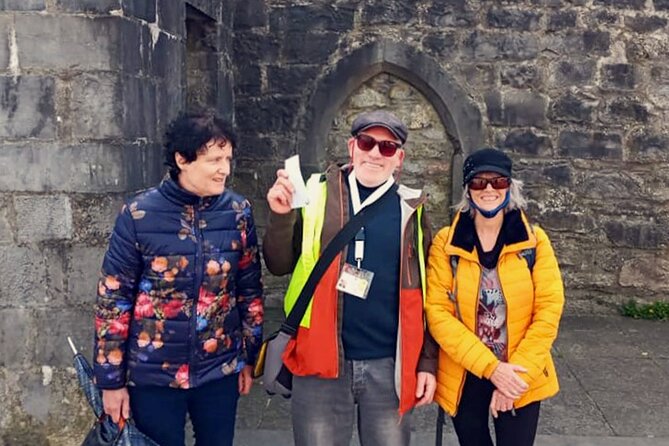
The tour meets at the front entrance of the Hardiman Hotel on Eyre Square (tell yourself that now, so you don’t spend the first five minutes hunting). From there, you head out across the city on foot and return to the same meeting point at the end.
This is offered in English and is built for small private groups of up to 13 people. That matters in Galway, where narrow lanes and busy intersections can turn group tours into a shuffle. With a private group, you can usually keep a steady pace and take photos without the whole line behind you tugging forward.
One practical thing: the tour runs on good weather. If conditions are poor enough for the provider to cancel, you’ll be offered a different date or a full refund.
More Historical Tours in Galway
- Galway: Dark History Guided City Walking Tour
★ 4.8 · 236 reviews - The Dark History Tour of Galway City
★ 5.0 · 146 reviews - Galway City on Foot with Seán: Stories, History, Local Tips, Chat and More..
★ 5.0 · 64 reviews
Eyre Square first: Tribes of Galway, the Browne Doorway, and JFK’s connection
Your first stop is Eyre Square, where you get a quick orientation and then a set of “look closer” moments around the square itself. You’ll hear local tales connected to the Tribes of Galway and see references to key landmarks you’d otherwise walk right past.
A few of the specifics you’ll be pointed to here:
- The old Browne Doorway
- The Tribes of Galway Banners
- The John F. Kennedy memorial connection
- The Quin-centenary Fountain
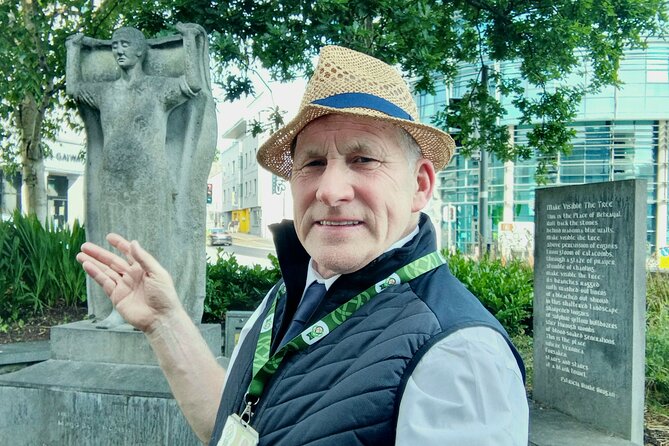
- The O’Connaire Statue
This opening section is more than a warmup. It’s how you learn the city’s logic. Galway history is layered, but it tends to show up in repeating themes: families, trade, religious power, and civic identity. Eyre Square sets those themes so later stops make more sense.
Williamsgate Street and Eglinton Street: shop-sign clues and a friary with a burial ground
After the square, the tour moves to Williamsgate Street. This is where you get architecture and street texture, not just famous sights. You’ll pass the elegant Browne Thomas building and see the jewelry shops where Claddagh rings are a Galway specialty.
If you have time, you’ll also see the Oscar Wilde statue, noted as an Estonia gift to Ireland in 2004. It’s a quick stop, but it’s the kind of detail that makes the city feel connected to the wider world.
Next you divert down Eglinton Street and pass the Franciscan Friary church. The useful part here is what the guide points out about the small graveyard behind it, described as a prominent burial place in the mid-17th and early 18th centuries. Even if you never walk into the graveyard, it changes how you read the street. Sacred spaces weren’t separate from daily life here.
Courthouse Square to Galway Cathedral: seeing “new” Europe alongside medieval roots
From there you head toward Courthouse Square, once home to two iconic courthouses, one for the county and one for the city. One remains today, with the Town Hall Theatre opposite. This is a short stop, but it’s a useful reset point, because it anchors Galway’s civic life in a visible location.
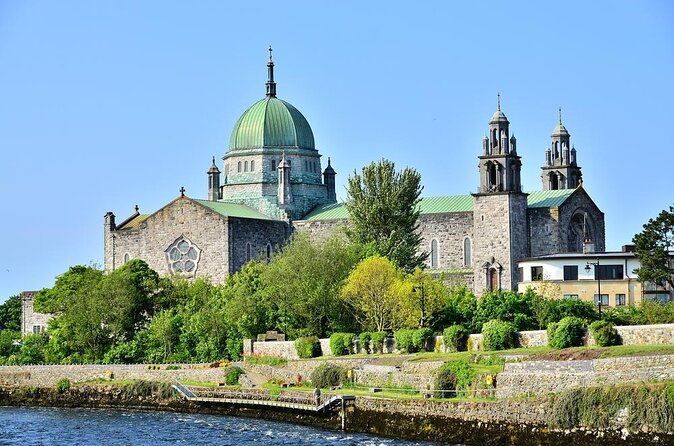
Then comes a bigger visual moment: the pause near the pedestrian bridge over the River Corrib for a view of Europe’s newest stone cathedral, the Galway Cathedral, along with the Franciscan Chapel nearby.
Two things make this stop valuable:
- It gives you river and skyline perspective, so your route stops feeling like random turns.
- It shows how Galway keeps building, even while it preserves older layers. You don’t just get medieval Galway. You get Galway as a living city.
More Walking Tours in Galway
- The Welcome to Galway Walking Tour
★ 5.0 · 427 reviews - Galway: Welcome to Galway Walking Tour
★ 4.8 · 338 reviews - Walking and Tasting Tour of Galway City
★ 5.0 · 283 reviews - The Legendary Walking Tour of Galway
★ 5.0 · 230 reviews
Lynch’s Castle and the River Walk: a town-castle that survived
The tour returns via the River Walk toward the main artery and arrives at Lynch’s Castle. This is described as the finest surviving Town-Castle in Ireland, once owned by the Lynch clan.
Your guide explains what you’re looking at, including:
- The building’s significance as a surviving town-castle
- The Lynch crests and roundels
- The sense of power that shows up in architecture and ownership
This stop is a highlight for history-minded walkers because castles in Ireland are often thought of as remote. Here, the castle feeling is inside the city fabric. You get the contrast: Galway as a place you live in, shop in, and stroll through, with deep history still visible on the street.
Dead Man’s Lane and the St Nicholas church-yard context
Next you turn into Church Lane, which was once called Dead Man’s Lane because funerals passed through on the way to the old graveyard. It’s one of those phrases that sounds dramatic until you picture the daily reality behind it.
You also talk about St Nicholas church-yard as the route continues toward the St Nicholas area. Even though you don’t spend ages here, the guide’s framing helps you understand why the city’s religious buildings mattered, not just as architecture but as institutions tied to community life and death.
The Lynch Memorial window: legend with a location you can stand on
In this stretch, you reach the Lynch Memorial stop, including the Lynch Memorial window, erected in 1854. The key story attached to this spot is a legend about Mayor Lynch and his son, where the tale says he hanged his own son at this location.
You don’t need to believe every detail to benefit from the stop. Places like this are how cities keep memory alive. Standing at the location helps you remember the stories better, and the guide ties it to why civic leaders were treated as larger-than-life figures.
St Nicholas Collegiate Church: the stop you build the whole walk around
St Nicholas’ Collegiate Church is where the tour turns from street orientation into real stop-and-look architecture. You arrive accompanied by your guide, who explains the church as the largest medieval church in continuous use in Ireland.
A few points that matter for your visit:
- It’s described as originally built as a Catholic church.
- Today it functions as a Protestant church.
- There’s a tradition that Christopher Columbus worshipped here in 1477, ahead of his voyage.
- You’ll also get help planning the next step inside with discounts for their guided tours.
The tour includes a voucher toward a visit to St Nicholas Church for 10am and 1pm tours only. Their guided tours are noted as operating Mon-Fri at 11am and 2pm, and on Wednesdays at 12pm and 3pm.
Tip: if you want the most out of this stop, time your day so you’re not sprinting from one attraction to the next. Even a guided walk through a church can be slow in the best way when you’re listening.
The Latin Quarter: King’s Head Pub legends, Dick Martyn, and Nora Barnacle
After St Nicholas, the route heads into Galway’s Latin Quarter on High Street. Here you’re in the older, denser layer of the city where names and stories tend to cluster.
The guide points out the King’s Head Pub, tied to a legend that the pub site was gifted by Oliver Cromwell as payment to the executioner of King Charles I. There’s also mention of Naughton House, once owned by an Irish MP known as Humanity Dick Martyn.
Then comes one of the best “wait, that’s here?” moments: the tour passes close to Bowling Green, the family home of Nora Barnacle. She’s described as a prominent Galwegian, famously dating Irish writer James Joyce on 16 June 1904. That date is tied to Bloomsday, the annual celebration of Joyce.
This is the part of the tour where you might feel the most connection to modern culture. The guide helps you see literature as part of the city’s physical geography, not just something that happened somewhere else.
Spanish Parade and the Spanish Arch: port life before 1840
Next you move to the open-space area known as the Spanish Parade, which used to contain the old Galway port until 1840. It’s a practical historical detail because it tells you when Galway’s relationship with Spain mattered most, at least in that specific space.
The guide connects the story to old galley ships arriving from Spain with wines and spices for local merchant families. You’ll also learn about the Spanish Arch just adjacent to the area.
If you like “how did people eat, trade, and ship goods” history, this stop delivers. It’s not just a pretty arch in a square. It’s the physical evidence of commerce.
Hall of the Red Earl and Druid Theatre: Norman ruins and modern writers
The tour loops back toward another medieval site: the Hall of the Red Earl. This was once the castle residence of the Norman Richard de Burgo, and it was important until the late 16th century. The ruins were reportedly lost for centuries and then discovered by archaeologists in the late 1990s.
From there you pass by Druid Theatre, linked to the Druid Theatre Company founded in 1975. The guide notes its relationship with writers Tom Murphy and Martin McDonough, and the fact that many well-known Irish actors and directors have worked with the company.
This is a nice tonal shift. You go from medieval power to a modern creative industry in just a short stretch of walking.
An Taibhdhearc and Abbeygate Street Lower: Irish-language culture and a former cathedral
The final culture-heavy stops bring you to An Taibhdhearc, described as Ireland’s only Irish-language theatre. It was established as a large-scale cultural project in the early 1920s, when Ireland became a Free State. The guide also mentions Micheal MacLiamor as the first director/manager, starting in 1928.
Then you wrap up with the former cathedral building on Middle Street / Abbeygate Street Lower. This structure is described as being in use for many centuries, but deemed inadequate by Galway bishop Dr Michael Browne in 1957.
In this final segment, the guide also references the Augustinian Order arriving in Galway in 1500 and setting up an abbey in an area called the Forthil. It notes that Oliver Cromwell’s English army banished them for a period, then they returned in 1760 to establish the building.
This ending works because it ties together themes you’ve already been hearing: religious authority, civic decisions, and cultural identity.
What you pay for this private group, and why it can be good value
The price is $150.60 per group, with a maximum of up to 13 people. That’s the big value lever here: if you’re traveling with family or friends and can fill your own group size, the cost per person drops fast. Even if you don’t fill the full capacity, you’re paying for a private guide rather than joining a big mixed group.
The other reason the math can work is that you’re getting more than “walk and point.” The route includes a voucher toward St Nicholas for specific tour times, plus a guide who’s set up to adapt the walking plan to what you want.
Also, this tour tends to be booked ahead, with an average of 61 days in advance. If you’re traveling in peak season, I’d treat that as a hint to lock in your preferred time.
Tips to make the 1 hour 55 minutes feel effortless
- Wear comfortable walking shoes. You’ll be moving through lanes and along river-facing stretches.
- Bring a rain layer, even if the forecast looks good. Galway weather can turn.
- Come with a couple of themes in mind, like architecture, families, or literature. The tour is easy to tailor, and that helps the guide steer you.
- If you want St Nicholas, plan your day around the voucher time windows. You don’t want to bump into a schedule conflict.
- If mobility is limited, ask about the shortened version. The provider notes plans for emergencies and route adjustments.
Should you book this Galway history walking tour?
Book it if you want a guided walk that does two jobs at once: it gives you Galway orientation and it turns the city’s names into something you can actually picture. The private group format, the heavy focus on recognizable places like Eyre Square and St Nicholas, and the story-rich stops like Lynch’s Castle and the Bloomsday connection make this feel practical, not just scenic.
Skip it or consider a shorter alternative if you hate walking in town streets or you’re visiting only for quick photo stops. This isn’t a drive-by tour. It’s built for listening, pausing, and learning in small chunks.
If you’re the kind of traveler who likes to understand why a city looks the way it does, this is an easy yes.
FAQ
How long is the Galway History Walking tour?
It’s approximately 1 hour 55 minutes.
What group size is this private tour?
It’s a private tour with up to 13 people.
Where do we meet, and where does the tour end?
You meet at the front entrance of the Hardiman Hotel on Eyre Square, Galway. The tour ends back at the same meeting point.
What language is the tour offered in?
The tour is offered in English.
Is there a St Nicholas Church visit included?
Yes. St Nicholas Collegiate Church includes an admission ticket, and you also receive a voucher toward a visit for specific guided-tour times.
What times does the St Nicholas Church voucher cover?
The voucher is for the 10am and 1pm tours only.
Is this tour fully outdoors?
The experience requires good weather, so it is designed for outdoor walking. If it’s cancelled due to poor weather, you’ll be offered a different date or a full refund.
Can the tour be shortened for mobility issues?
Yes. A shortened version can be offered to guests with mobility issues.
Can I cancel for a full refund?
Yes, you can cancel up to 24 hours in advance for a full refund.
Newest Galway reviews
- Irish Stew Traditional Recipe with lunch★ 5.0 · 24 reviews
- Galway: Connemara, Sheepdog Show and Medieval Castle Tour★ 5.0 · 24 reviews
- Private Connemara Day Tour★ 5.0 · 25 reviews
- Sheepdog herding demo on working sheep farm. Galway. Guided.★ 4.8 · 25 reviews
- Private Half Day Tour To Connemara★ 5.0 · 25 reviews
- Personal Private Driver★ 5.0 · 27 reviews
- Deserted Island Private Landing Tour★ 5.0 · 28 reviews
- Oyster Farm and Tasting Experience★ 4.5 · 33 reviews
Historical Tours, compared.

Dublin Historical Centre Food Tour with 8 Food Tastings & Drinks
Read our review →
Historical 2-Hour Guided Walking Tour of Dublin
Read our review →
Dublin to Cork, Blarney Castle & Cóbh Heritage Centre by train
Read our review →
Jeanie Johnston Tall Ship Irish Famine History Tour
Read our review →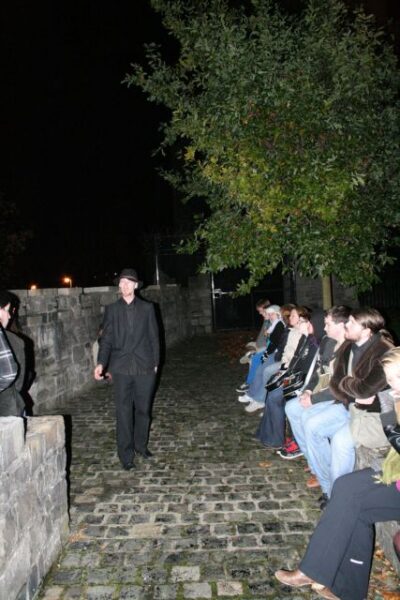

Deliciously Dublin: The Artisan Donut Walking & History Tour
Read our review →Browse the lists this tour appears in